

The placement cell's problem is not placements
Ztwin
A placement officer is measured on one number in April and given no way to move it between June and March. That is the whole problem, and it is not a problem about placements.
Campus hiring has changed shape. Companies are hiring for different skills than they were three years ago, students are applying to far more roles, AI is rewriting job requirements faster than any curriculum committee can meet, and institutions are now expected to demonstrate employability outcomes rather than assert them. The placement office, meanwhile, still runs on spreadsheets, WhatsApp groups, email threads, an aptitude test, a pile of resumes and a great deal of manual follow-up.
The problem is not that placement officers are not working hard. The problem is that the system around them never caught up with the job they are now being asked to do.
The short version
- Eligibility is measurable; readiness is not. Only 42.6% of Indian graduates applying for jobs are assessed as employable, and nothing in a student's record predicts which side of that line they fall on. 1
- Batch-wide training cannot fix individual gaps. Two students in the same branch can need opposite interventions.
- Administration eats the week. None of it makes a student more employable, and all of it consumes the one person whose judgement is scarce.
- Rejections generate evidence that nobody captures. Every drive is a free assessment of the institution's own students, discarded at the end of the day.
- The fix is a single record, not another tool. Assessment, intervention and hiring outcome have to write to the same place before any of them compound.
What this article covers
- How campus hiring outgrew the placement office
- Five problems every placement cell is running into
- What the answer looks like: an employability layer
- Where AI actually helps in campus placement
- The placement office as an employability command centre
- The employability loop
- Frequently asked questions
How campus hiring outgrew the placement office
For years the job description of a placement officer was short enough to fit on a slide. Bring companies to campus. Circulate the JD to eligible students. Coordinate the tests and the interviews. Track the offers. Report the numbers in April.
Every one of those five is a coordination task, and the tooling on most campuses is built for exactly that — a calendar, a mailing list and a spreadsheet of who applied where. It works right up until the question changes from did the drive happen to were our students ready for it, which is the question institutions are now being asked.

Five problems every placement cell is running into
1. Student readiness is invisible
A placement officer can tell you that a student has a 7.8 CGPA, three certifications and a resume on file. That is eligibility, and eligibility is easy to measure.
Whether the same student can explain their own project under questioning, communicate clearly for forty minutes, reason through a problem they have not seen before, or work alongside AI tools is a different question entirely — and nothing in the record answers it.
Mercer | Mettl's India Graduate Skill Index 2025 assessed over a million students across 2,700-plus campuses and found only 42.6% of Indian graduates applying for jobs were overall employable, with critical thinking, communication and learning agility weighing alongside technical skill. 1
That gap between eligible and ready is where the placement office loses most of its year.
2. The same training goes to everyone
The standard response is a programme: aptitude training for the batch, a communication module, a coding bootcamp, a round of mock interviews, a resume template.
Students do not start from the same place, so a single programme cannot land on all of them. A student heading for a software role needs an entirely different intervention from one heading for sales, finance, analytics or operations — and inside a single branch, two students can need opposite things. One needs speaking practice. One needs DSA. One is technically strong and falls apart in an interview. One has no idea which roles suit them.
The shift worth making is from training everyone to identifying what each student needs.
3. Job descriptions move faster than training cycles
AI, data, cybersecurity, cloud and automation are changing what employers ask for on a timescale shorter than an academic year. NIIT's India Skills Gap Report 2026, drawn from 3,500 students, professionals, recruiters, CXOs and academic leaders, puts AI, cybersecurity, digital and data skills among the capabilities that will define the Indian workforce. 2
A training plan fixed in June may already be answering last year's question by the time the season opens. What the office needs is not a better plan made earlier, but a loop: what are companies hiring for, what do our students have, where is the distance, what happens next.
4. Most of the week goes to administration
Collecting student data. Checking eligibility. Sending announcements. Managing registrations. Taking attendance. Coordinating tests. Chasing students. Maintaining the sheet. Updating offer status. Preparing the report. Answering the same question thirty times.
None of that makes a single student more employable, and all of it consumes the bandwidth of the one person on campus whose judgement about employers, students and gaps is the scarce resource.
Which is the real argument for automating placement administration, and it is not "replace spreadsheets with software". It is returning the hours to the work that actually requires a human.
5. Rejections teach nobody anything
A student applies to ten companies and is rejected by eight. What did those eight rejections teach anyone?
The student usually learns only the round they fell at — not whether the underlying cause was technical depth, communication, reasoning, resume quality, role fit, thin project experience or simply not having prepared. Without that, the same mistake gets repeated in the ninth application.
The institution loses more. Every hiring cycle generates evidence about its own students and almost none of it is captured. The difference is between an officer saying:
Students need better communication.
and an officer saying:
Students applying for analyst roles clear aptitude comfortably and then underperform in structured interviews and case-based problem solving.
Only one of those is a problem somebody can act on. Getting from the first sentence to the second is a measurement problem before it is a technology one, and the six measures that do it are a separate post.
What the answer looks like: an employability layer
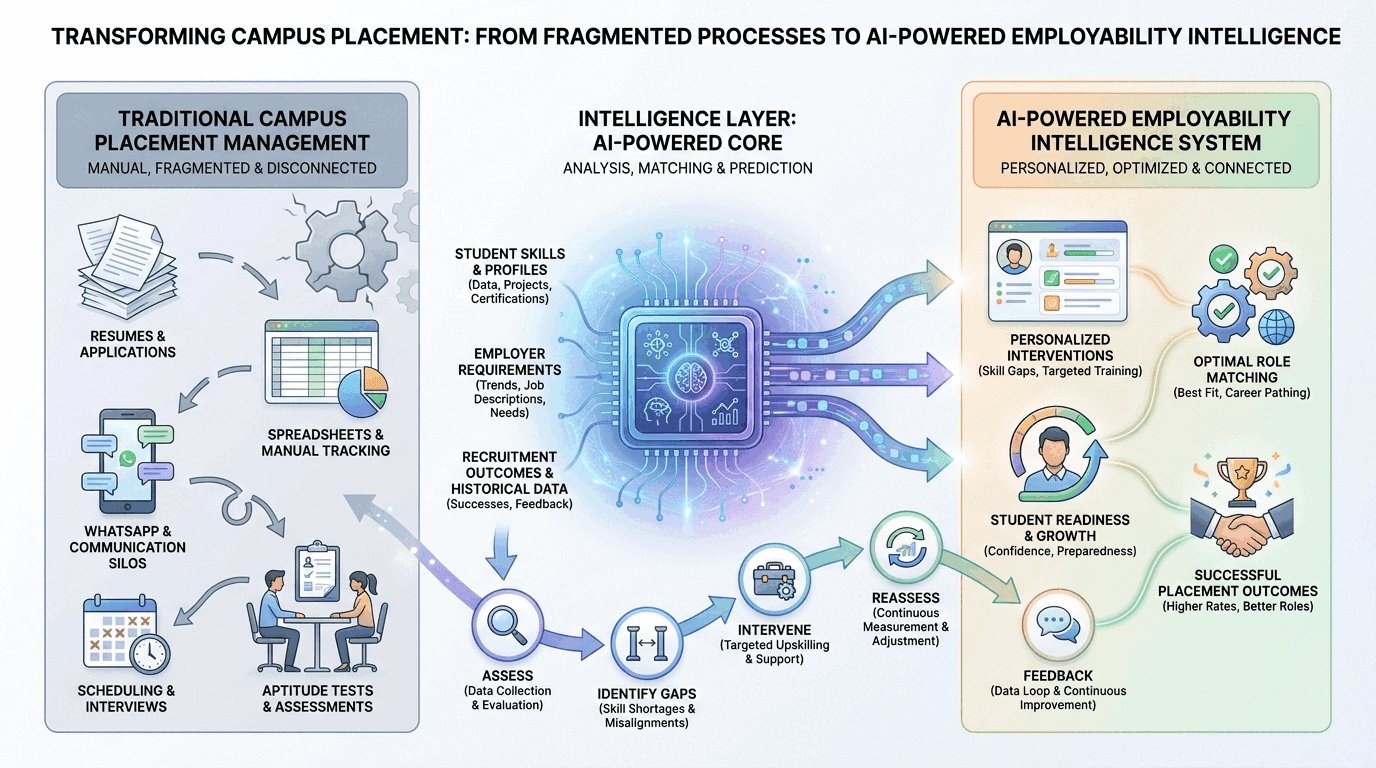
Not another job board. Not another resume builder. Not another mock-interview tool bolted on beside the others. The opening is an employability layer underneath the placement office — one record that the assessment, the intervention and the hiring outcome all write to.
A readiness profile that moves
Instead of a record holding CGPA, branch and a resume, each student carries a profile that changes as they do: academic performance, technical and communication assessments, interview performance, projects, certifications, stated role preferences, application history and whatever employers said on the way out.
The important property is not the number of fields. It is that the profile is never finished.
Readiness against a role, not in general
"Placement ready" is not a property of a student. It is a property of a student and a role.
Software engineer — 72%
Strong: programming, SQL, problem solving.
Weak: DSA, system design fundamentals, interview communication.
Business analyst — 81%
Strong: Excel, communication, analytical reasoning.
Weak: case interviews.
That tells a placement officer what to do on a Tuesday. A single employability score does not.
Interventions that name the next action
Once a gap is identified, the output should be an action small enough to actually happen — not "complete this 40-hour course" but "interview performance is the binding constraint for your target roles; do two mock interviews, work these five question categories, reassess".
Identify, intervene, reassess, improve. The value is in the fourth step, which is the one almost every training programme skips.
Employer feedback as institutional memory
Every drive produces information: which skills were tested, where students struggled, which profiles got shortlisted, what caused rejection, which signals correlated with selection. Most institutions never convert any of it into next year's decision.
63 students applied for data analyst roles. 28 cleared aptitude. 17 cleared the technical assessment. 8 reached an interview. 3 were selected. The recurring gap: SQL and structured communication.
Now the next training cycle has a reason behind it rather than a habit.
Where AI actually helps in campus placement
The useful question is not whether to use AI. It is where AI reduces the load on a placement team while improving the quality of a decision. On that test, four things hold up:
| Where it helps | What changes for the cell |
|---|---|
| Continuous assessment of technical, communication and role-specific skills | Readiness is current in March instead of stale from an October snapshot |
| Interview practice at volume, with structured feedback | Every student gets repetition; no officer sits through six hundred sessions |
| Skill-gap detection against a real job description | The gap is named against what a specific employer asked for, not in the abstract |
| Placement analytics by branch, role and drive | The term plan starts from where gaps cluster, not from last year's calendar |
Two cautions worth stating plainly. A readiness or ATS score computed with no job description attached is decoration — the comparison is the entire content of the number. And a system designed to remove the placement officer from the loop is solving the wrong problem: the scarce thing on campus is not effort, it is a clear view of six hundred students at once. That is the thing worth automating.
The placement office as an employability command centre

The end state is less "a better placement-management system" and more an employability command centre — one screen that answers, on any given morning:
Students. Who is ready? Who is improving? Who is at risk? Where do the gaps cluster?
Employers. What roles are coming? What are they asking for? Who is closest?
Interventions. Which programmes moved outcomes? Which ones did not?
Outcomes. Where are students being rejected, why, and what should change before the next cycle?
That list is a specification, and what a placement cell should actually measure works through the numbers behind each line of it. An officer working from that view is doing a different job from one working from a spreadsheet. Placement coordinator becomes employability strategist, and the title is not the point — the leverage is.
The employability loop
Campus placement is usually framed as one question: how do we get more companies to hire our students? That is half of it. The other half is how do we systematically make more students ready for the jobs those companies are already hiring for?
The two halves feed each other. Better readiness produces better hiring outcomes. Better hiring data produces better training decisions. Better training strengthens employer relationships. Stronger relationships bring better opportunities to the next batch.
Student → assessment → gap → intervention → employer → outcome → feedback → readiness, and around again. The institutions that close that loop will pull ahead of the ones that keep treating placement as the last six weeks of a degree.
Employability is not an event at the end. It is something an institution measures, improves and manages the whole way through — and that is where the real opportunity for technology in campus placements sits.
Frequently asked questions
What does placement readiness actually mean?
Readiness is the distance between what a student can demonstrate and what a specific role requires. It is not a property of the student alone, which is why a single "employability score" is hard to act on — the same student can be 81% ready for a business analyst role and 55% ready for a backend engineering one.
How is employability different from placement percentage?
Placement percentage is an outcome measured once, after the season, across the batch. Employability is a state each student is in throughout the degree, and it is the thing that produces the percentage. A cell that can only see the first number is steering by looking at the wake — what a placement cell should actually measure covers the in-season alternatives.
Can AI replace the placement officer?
No, and a system built on that premise misreads the job. Assessment at volume, interview practice and gap analysis are load; employer relationships, judgement about individual students and decisions about what the institution changes next are the work. AI moves the first category off the officer's desk so there is time for the second.
Where should a placement cell start?
With the record, not the tooling. If applications live in a Google Form, shortlists live in email and readiness lives in one officer's head, every useful question costs a week of manual work. Once assessment, drives and outcomes write to one place, the measures and the loop come almost free.
Sources
Footnotes
-
Mercer | Mettl, India's Graduate Skill Index 2025 — over one million students assessed across 2,700+ campuses in 31 states and union territories. ↩ ↩2
-
NIIT, India Skills Gap Report 2026, conducted with YouGov across 3,500 respondents. ↩